

November is Make a Will Month and Financial Literacy Month in Canada. It’s a good time to take stock of your finances and the to-dos you keep putting off. For the third year, Willful asked Canadians how the cost of living is affecting their financial plans. This year, we also looked at the sandwich generation for the first time.
A letter from Erin Bury, CEO and Co-founder of Willful
This is the third year we've asked Canadians how the cost of living is shaping their financial plans. The short version: people got more done this year, and they still feel worse off.
That's the paradox at the heart of The Great Delay 2026. Nearly everyone saw their grocery bill go up. Most saw gas go up too. Almost half dipped into savings to get through the month. And yet more Canadians than last year managed to save, pay down debt, or contribute to a TFSA. People are working hard.
What slipped is the stuff that protects your family if something goes wrong. More Canadians put off getting or updating a will this year than last. Fewer have both talked about an emergency plan and put the documents in place. Three years in, the share of Canadians with a will hasn't moved.
This year we also looked at the sandwich generation for the first time, Canadians with at least one living parent and a child of any age. I'm one of them. As a mom of two and a daughter myself, I know how quickly the pressures stack up, and how easy it is to put your own plan last when you're looking after everyone else. The data says I'm not alone. The sandwich generation is checking more boxes than any other group, and still falling further behind, and the box they're most likely to skip is their own will.
November is Make a Will Month and Financial Literacy Month, and if this report does one thing, I hope it helps you cross one big thing off the list.

Erin Bury
Co-founder and CEO, Willful.
1. Food and fuel drove the squeeze this year
For almost all Canadians, it felt like every trip to the grocery store and the gas station cost more this year.
97% of Canadians say their grocery costs went up over the past 12 months, by an average of 21%. 84% say gas went up, by an average of 24%. Dining out (85%) and utility bills (82%) weren't far behind.
Those everyday costs are what people say is standing between them and their goals. When we asked what's hurting their ability to get ahead, rising grocery and food costs came first (82%), followed by overall inflation (79%) and energy and fuel costs (62%). Tariffs, the big story in 2025, are still on the list at 32%, but they've been overtaken by the basics.
Almost half of Canadians feel worse off than a year ago
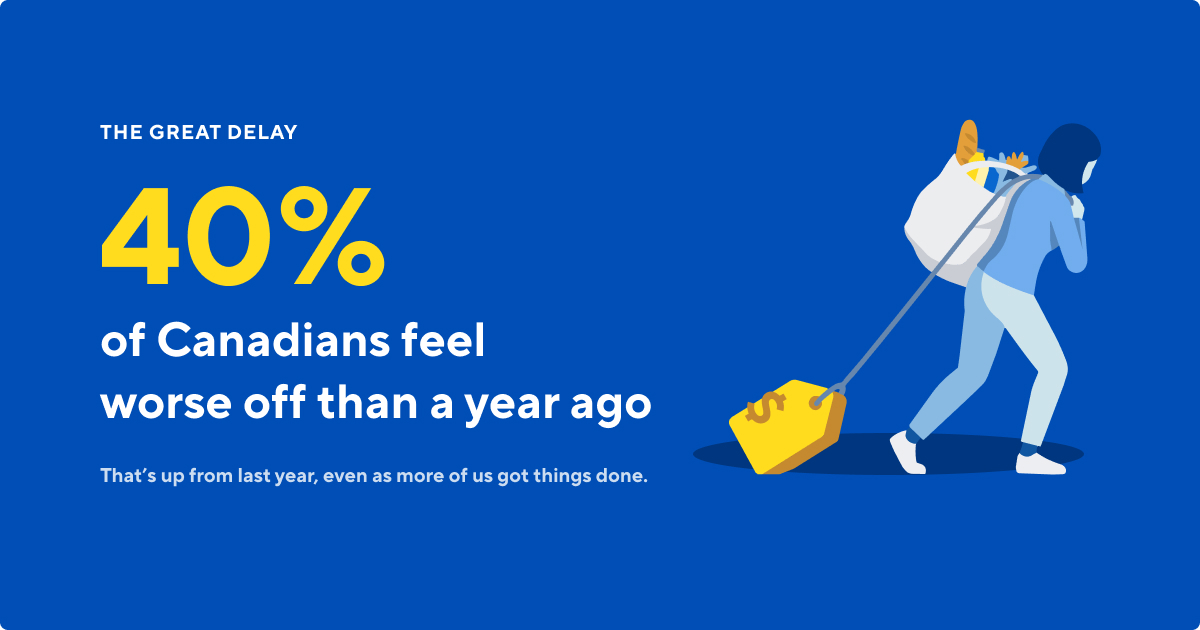
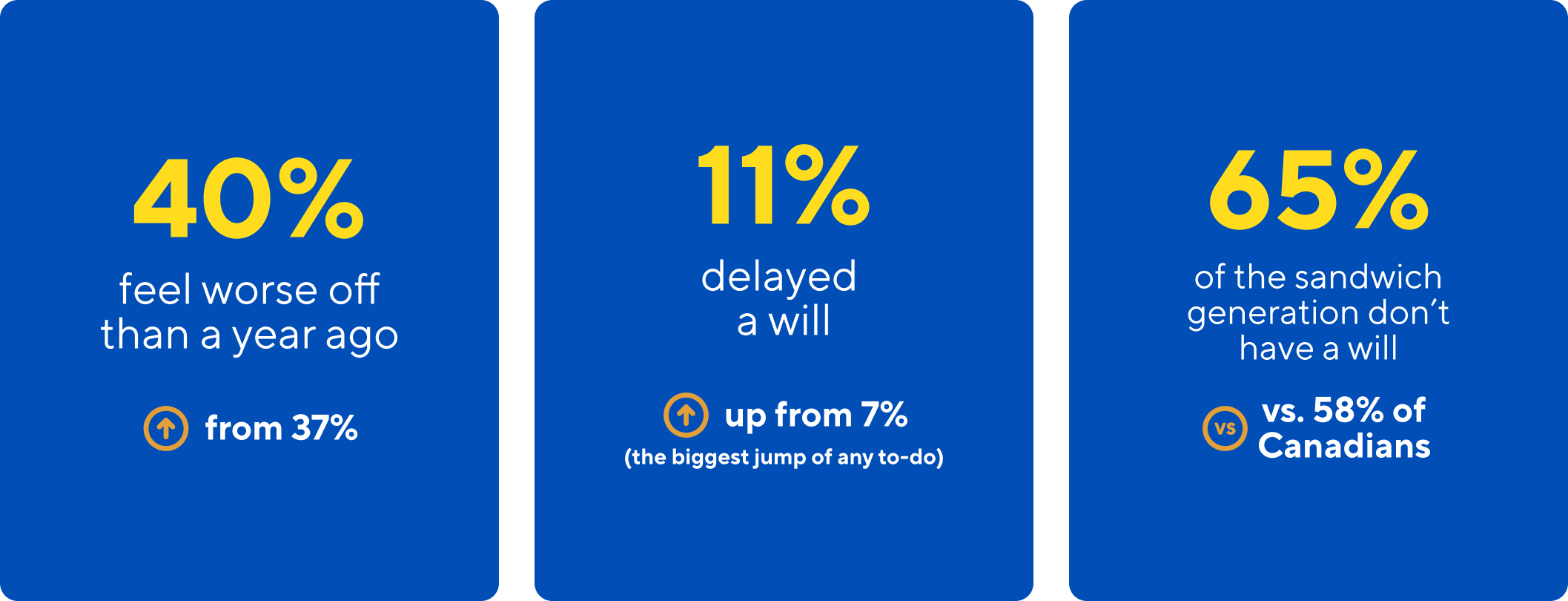
Two in five Canadians (40%) say they're in a worse financial position than they were a year ago. That's up from 37% who said the same last year, and only 22% say they're better off.
Gen X is feeling it most. 47% say they're worse off, and 52% say their debt repayment costs went up, compared with 44% of Canadians overall. Boomers are the least likely to say they're better off, at 13%.
Gen Z is the exception. It's the only generation where more people say they're better off (36%) than worse off (29%).
Savings are still the emergency fund
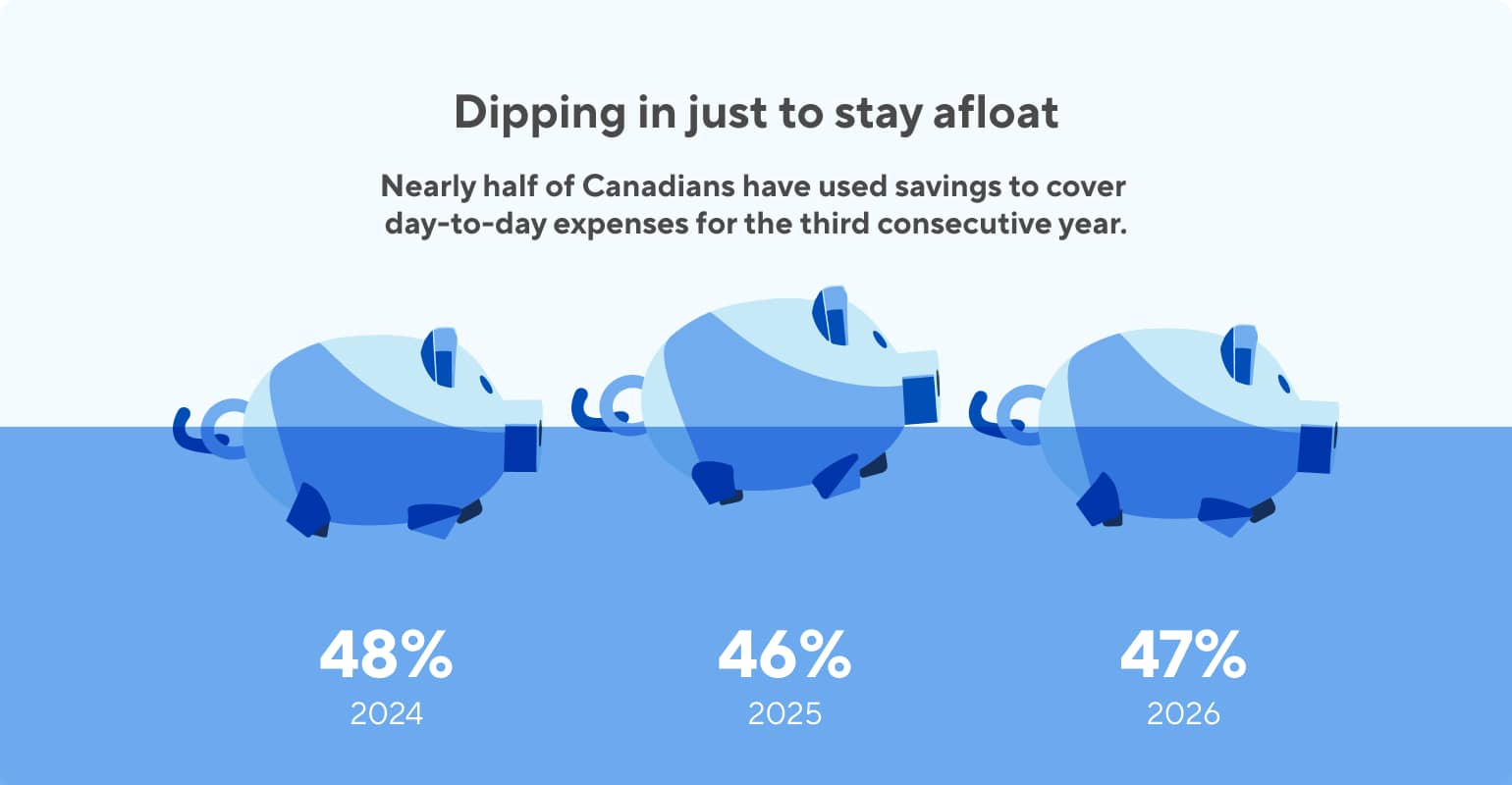
Nearly half of Canadians (47%) have used savings to cover day-to-day expenses in the past year. That's the third year in a row the number has landed near half: 48% in 2024, 46% in 2025, 47% now. Another 7% say they have no savings to dip into.
Gen X leads here too, at 55%. The sandwich generation is at 52%.
It's a reminder that for a lot of households, savings aren't going toward a goal. They're covering the gap between paycheques.
The $818 gap, and what people think would close it
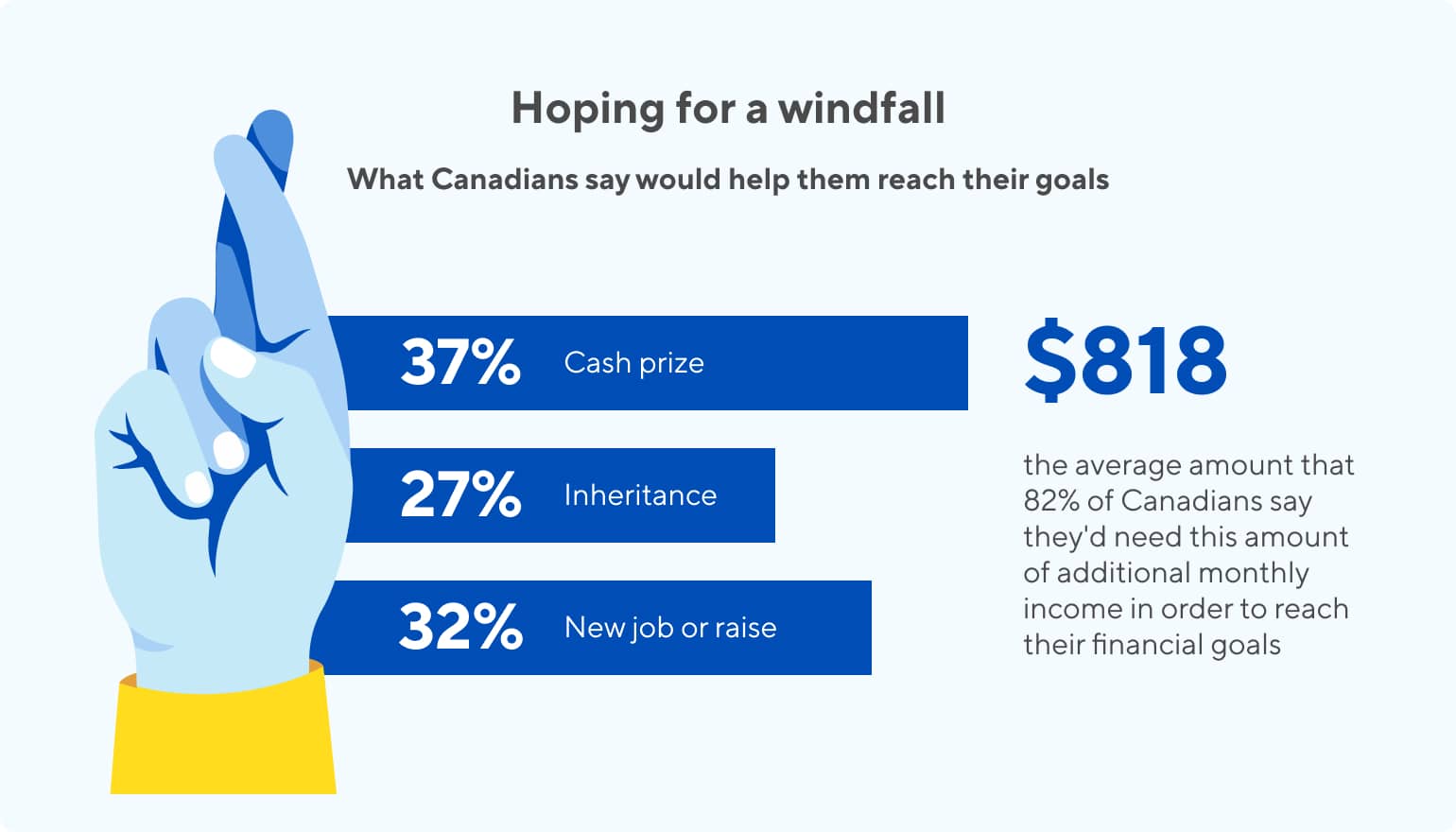
82% of Canadians say they'd need more monthly income to reach their financial goals. Among those who do, the average is an extra $818 a month, and 36% say they'd need $1,000 or more. Millennials and Gen X are the most likely to need $1,000 or more, at 44% each.
So what would actually help? Most people point to costs coming down. 64% say a drop in everyday costs or inflation easing would make the biggest difference. But the next most common answers are a windfall: 37% say a cash gift or prize, and 27% say an inheritance. Only 32% say a new job, promotion, or raise, though that jumps to 56% among Gen Z, who are also twice as likely as the average Canadian to say the tough job market is holding them back (36% vs 17%).
2. Canadians are still delaying life's biggest to-dos
More than half of Canadians (55%) say the economy forced them to delay a major financial milestone or to-do this year. That's a touch better than 2025 (58%), but it's still most of the country, and it's not spread evenly across generations.
70% of Millennials delayed a financial to-do this year, the most of any generation, compared with 36% of Boomers. Gen Z (29%) and Millennials (30%) are also the most likely to have put off buying a home or getting married. More than one in ten Gen Z Canadians (11%) put off getting married or having a wedding this year.
What got pushed
The to-dos Canadians most often delayed this year:
- Saving for the future: 31%
- Paying off debt: 21%
- Opening or contributing to a TFSA: 13%
- Buying a home: 13%
- Getting or updating a will: 11%
- Opening or contributing to an RRSP: 11%
Millennials and Gen X were the most likely to delay saving (40% each). Millennials were also the most likely to put off buying a home (23%).
The good news: people got more done this year
Here's the part that surprised us. 77% of Canadians completed at least one financial to-do this year, up from 66% in 2025. Fewer people did nothing at all (23% vs 34%).
More Canadians saved for the future (38% vs 30%), contributed to a TFSA (38% vs 30%), paid off debt (32% vs 26%), and contributed to an RRSP (23% vs 19%). Gen Z led the way on saving, with 53% putting money away for the future, more than double the rate of Boomers (24%), which makes sense as many older Canadians aren’t saving for the future, they’re living off their savings in retirement.
So the picture isn't that Canadians stopped trying to check things off their list. It's that they're so focused on the day-to-day needs that future planning fell off the list.
The to-do that slipped most: a will
11% of Canadians delayed getting or updating a will this year, up from 7% in 2025. That's the biggest jump of any item on the list. Delays on power of attorney documents also rose, from 4% to 6%.
Gen X (14%) and Millennials (13%) were the most likely to put off a will. Boomers were the most likely to get one done (20% got or updated a will this year, vs 11% of Canadians overall).
And for the third year running, the share of Canadians with a will hasn't moved. 41% in 2024. 40% in 2025. 42% in 2026. Power of attorney documents are stuck too, at 27%, 24%, and 27%. Three years of cost pressure, and the needle is exactly where it started, with less than half of Canadians protecting their legacy.
On Willful, the picture is a bit brighter. Will completions rose 10% in the first nine months of 2026 compared with the same period last year, and Gen Z completions grew the fastest of any generation, up 71%. Millennials made the most wills of any group, 44% of the total. But power of attorney completions fell 8% over the same period.
3. The sandwich generation is doing the most, and still falling behind
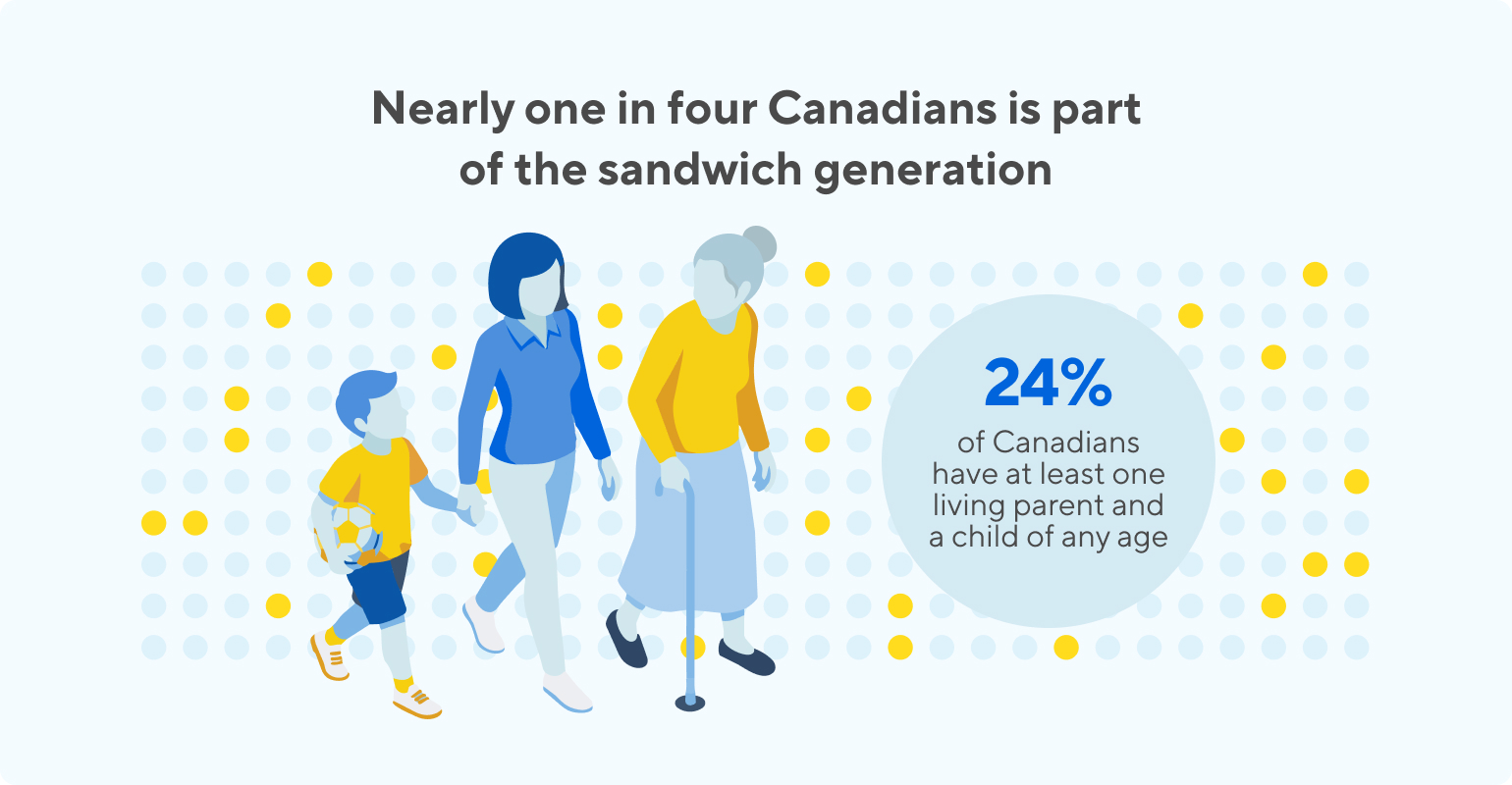
Nearly one in four Canadians (24%) is part of the sandwich generation: they have at least one living parent and a child of any age. That's roughly a third of Gen Z, Millennials, and Gen X. This is the first year we've looked at them as their own group, and the story is clear: they're working harder on their finances than anyone else, and the plan that keeps slipping is their own.
Squeezed from both directions
On top of the costs that come with kids and aging parents, the sandwich generation is more likely to see the everyday bills climb too.
They're more likely than the average Canadian to say their debt repayments went up (49% vs 44%), their car payments (31% vs 25%), and their life insurance premiums (32% vs 25%). Nearly half carry a mortgage (48% vs 35%), and they're much more likely to name rising mortgage renewal rates as a barrier to their goals (25% vs 15%).
It adds up. 52% have dipped into savings to cover day-to-day costs, 41% feel worse off than a year ago, and 88% say they'd need more income to reach their goals. 71% need at least $500 more a month, and 41% need $1,000 or more.
Checking more boxes, but still delaying more than anyone
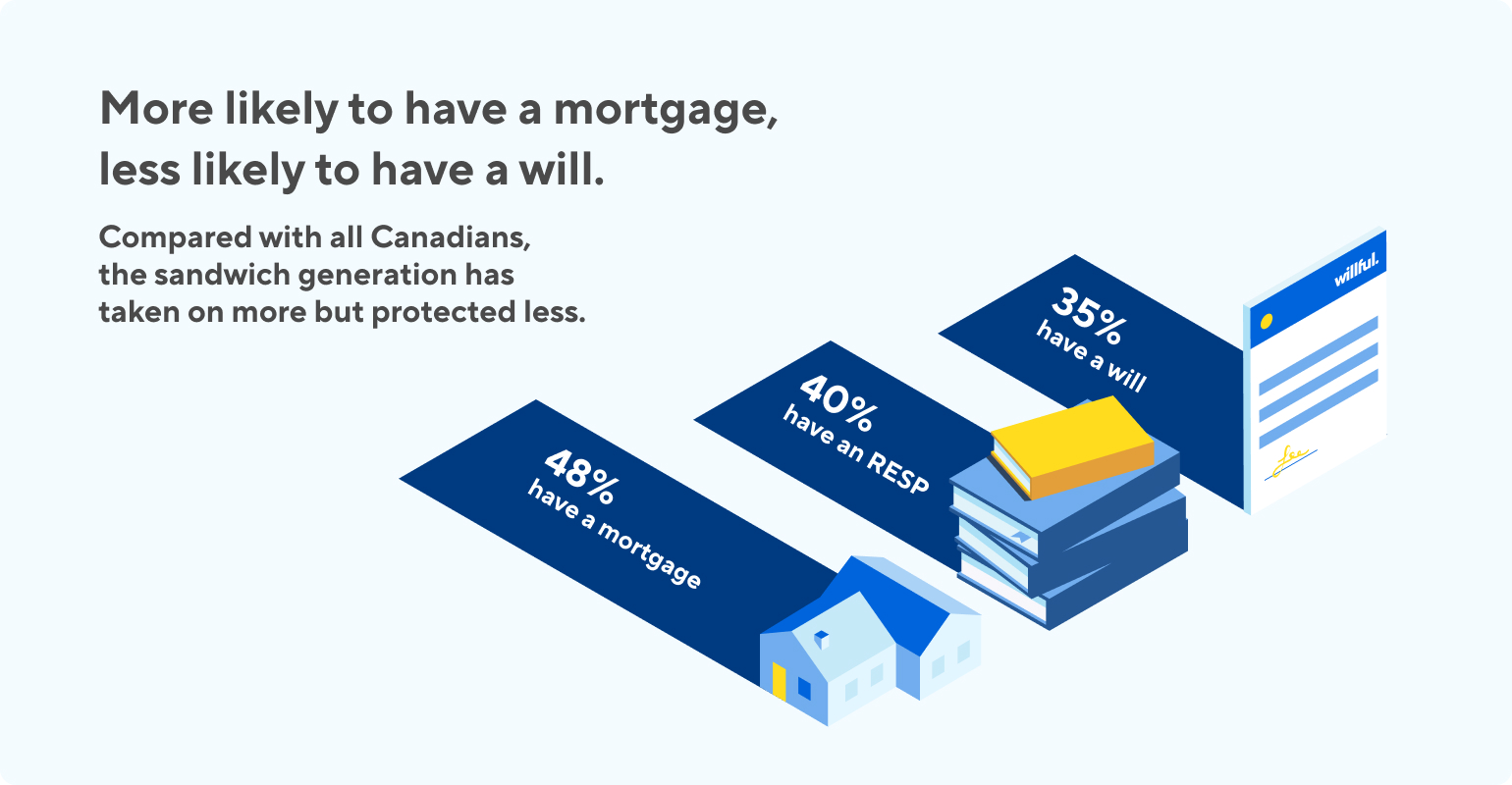
Despite those pressures, they’re still making progress. 81% of sandwich generation Canadians completed at least one financial to-do this year, compared with 77% of Canadians overall. They were more likely to save for the future (47% vs 38%), contribute to an RRSP (30% vs 23%), and contribute to an RESP (21% vs 7%).
Even so, 63% delayed a major financial to-do this year, compared with 55% of Canadians overall. They were more likely to put off saving or investing (44% vs 38%) and paying off debt (27% vs 21%).
Planning for everyone but themselves
This is the part that matters most to us. The sandwich generation has invested in their kids and protected their income. 40% have an RESP, and 42% hold their own life insurance, compared with 34% of all Canadians.
But 65% don’t have a will, compared with 58% of Canadians overall. Only 23% have power of attorney documents, compared with 27%. They were more likely than anyone to delay estate planning this year (21% vs 15%), and 13% specifically put off a will.
Think about who's counting on them. They have kids who'd need a guardian named. They have aging parents who may need their support one day. They're the people for whom a will matters most, and they're the least likely to have one.
4. Families are still unprepared for the inevitable
Nearly two in three Canadians (63%) aren't fully prepared for a financial emergency like a job loss or the death of a family member. That means they haven't both talked through a plan with their family and put the proper documents, like a will, in place. It's up from 60% last year.
The gap is widest for the generations with the most at stake. 77% of Millennials aren't fully prepared, compared with 44% of Boomers. Just 14% of Millennials and 9% of Gen Z have both the conversation and the paperwork done, compared with 47% of Boomers.
The conversation gap
One number in here stood out to us. 16% of Canadians have talked about an emergency plan with their family but never put the documents in place. Among Millennials, it's 23%. Among the sandwich generation, it's 24%, nearly double the rate of other Canadians.
These are people who've done the hard part. They've had the awkward conversation. They just haven't finished it. If that's you, the paperwork is the easy part.
A will is still the exception, not the rule
58% of Canadians don't have a will. The generational split is stark: 8% of Gen Z, 17% of Millennials, 42% of Gen X, and 76% of Boomers have one.
The Millennial number deserves a closer look. Only 17% have a will, but 34% have a child under 18, more than any other generation, and 45% have a mortgage. They've taken on the two biggest responsibilities most people ever take on, and most haven't written down what happens to either one.
5. The emotional cost of delay
Canadians know what's at stake when someone they love hasn't planned. We asked what would happen if their parents or immediate family members passed away without a will.
- 63% say it would cause stress among family members
- 51% say it would make financial and legal tasks difficult to manage
- 41% say it would make them anxious about their own financial security
- 34% say it would cause conflict among family members
- 29% say it would delay their own financial goals
Those numbers are steady from last year (65%, 53%, 42%, 37%, and 31% in 2025). The worry hasn't gone anywhere. Neither has the gap.
The sandwich generation feels it most
For the sandwich generation, a parent's planning gap is their problem too. 74% say a family member dying without a will would cause stress in the family, compared with 63% of Canadians overall. 59% say it would make the financial and legal tasks hard to manage (vs 51%). Half (51%) say it would make them anxious about their own financial security (vs 41%). 41% expect conflict (vs 34%). And 38% say it would delay their own financial goals (vs 29%).
In other words, the people most likely to be the executor, the caregiver, and the one holding the family together are also the ones most likely to say the fallout would land on them.
What you can do this Make a Will Month

The easiest way to create your legal will. No lawyer required.
Start your will today →About the data
Willful commissioned Angus Reid to survey 1,501 Canadian adults from September 1st to 10th, 2026, including a subgroup of sandwich generation Canadians, defined as those with at least one living parent and a child under 18. The survey was conducted in English and French. For comparison purposes only, a probability sample of this size would carry a margin of error of plus or minus 2.5 percentage points, 19 times out of 20. Comparisons with 2025 and 2024 draw on Willful's earlier Great Delay surveys, also conducted with Angus Reid.
Willful platform figures come from anonymized, aggregated activity on Willful from January 1st to September 30th, 2026, compared with the same period in 2025. A will or power of attorney counts as completed the first time a user generates that document. Platform figures reflect Canadians using Willful, including through employer and partner programs, and aren't a representative sample of all Canadians.
Read the 2025 report and the 2024 report.


 Rising costs and financial pressure
 Income gaps
 Delayed financial to-dos and wills
 Emergency preparedness
 The sandwich generation
